Loading...
Loading...
Description
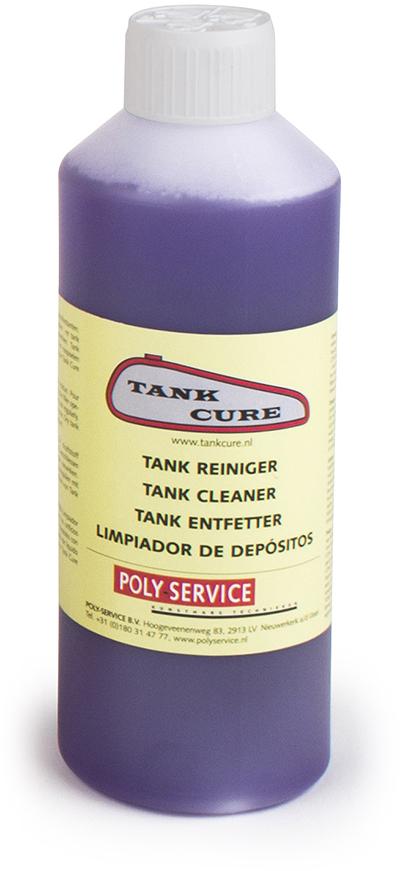
Tank Cure is the product to professionally restore the inside of your fuel tank. Tank Cure is a product of POLY-SERVICE and has been applied with very good experience within Europe for more than 25 years. Tank Cure is gasoline and oil resistant. It has been successfully applied to metal tanks for both oil, diesel, and gasoline.
Sealing off rust
Sealing small leaks (porosity, leaking welds, or holes)
Preventive treatment against leakage and rust formation
Shielding from contamination in oil tanks (e.g. after sandblasting)
Epoxy fuel tank coating, the remedy for leaking and rusted fuel tanks.
Applications and properties
Gasoline tanks that are porous or rusted on the inside can be successfully treated with the Tank Cure System. The result is a plastic coating that seals small holes and prevents rusting. Tank Cure epoxy coating has been used successfully for many years in various countries in Europe. For environmental reasons, increasingly higher percentages of Bio-Ethanol have been added to gasoline in recent years. This addition will increase the risk of corrosion in the tank and therefore will make the requirements for Tank Cure Coating increasingly higher. The Tank Cure Coating formulation has therefore been modified whereby the viscosity has also been increased in order to achieve a thicker protective layer in the tank. To achieve sufficient layer thickness on the inside, a 450-gram set of Tank Cure Coating is needed for a tank up to 15 liters.
Points of interest
In an extensive laboratory study, it has been found that when the percentage of Bio-Ethanol is greatly increased, the resistance of the coating decreases. Therefore, Tank Cure is not suitable for fuel containing more than 10% Bio-Ethanol. When a tank is treated with Tank Cure Coating, it is not recommended to add aggressive carburetor cleaners to the gasoline, as this may affect the coating layer.
Mixing the components
A set of Tank Cure Tank Sealant consists of base component A and hardener component B in the right mixing ratio. There is sufficient space in the packaging of the A-component to add the B-component for mixing.
After removing the red cap from the B-component canister, remove the aluminum seal completely to allow the canister to drain completely. Then stir the components intensively for a few minutes with a stirring stick. To prevent mixing errors, the mixture should be poured into a clean container or mixing cup and stirred well again. If only a portion is used, carefully weigh both components in the correct mixing ratio (100:50 parts by weight).
Product Fitment
Brand
Tank Cure

Tank Cure is a solvent-free 2-component epoxy coating with excellent fuel and oil resistance. Beyond very specific product information, we offer a lot of general information on applying coatings to seal gasoline and oil tanks. A problem that often comes up with members of vintage motorcycle and moped clubs is a gasoline tank that is rusting, porous from the inside and/or leaking. Treating it by hand, such as rust spots on the outside, is obviously impossible.
Often, enthusiasts of these vintage mopeds have to look for a used tank. However, these are becoming increasingly scarce and therefore more expensive. There is another sustainable solution. With the Tank Cure System, the tank can be repaired properly and permanently. Not only will rust be counteracted, any holes will also be sealed. Tank Cure is a product of Poly Service and has been used successfully in several European countries since 1994.
Related products
-

-
Fluids & Lubricants
Morris Lubricants K99 Water Resistant Grease 500g
£10.42 inc. VAT
£8.68 excl. VAT
Add to basket